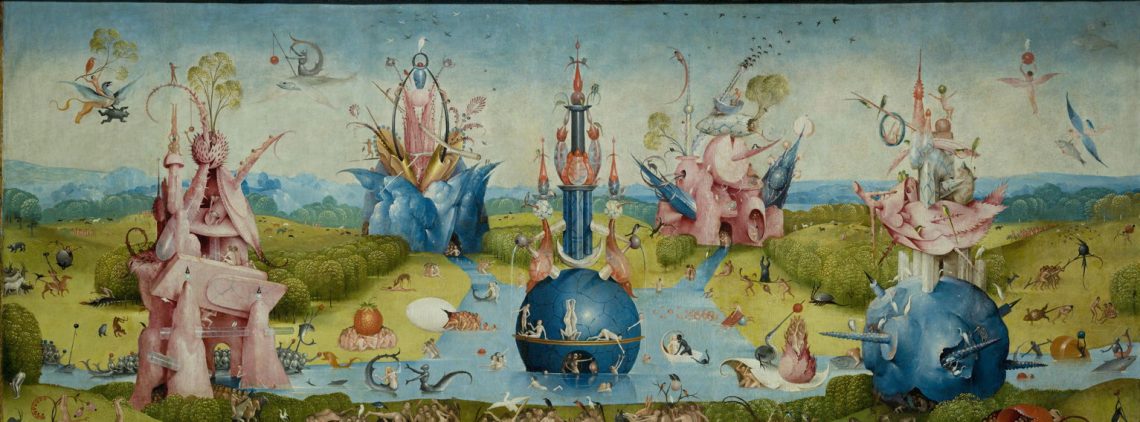

“The Dreamer”
What can we be sure of? What can we know without any doubt? Our own existence? Or that of the world in which we find ourselves? What is more sure, the existence of the solid matter we experience, or the conscious experience itself? What is an experience? What is a thought? I am thinking, I am having experiences, I am experiencing a world of solid matter around me. What is more sure, the existence of that world, or the existence of me, the being that is experiencing it? Would that world still be there if I was not there to experience it? Does it exist on its own, outside of me? How can I know for sure?
Imagine picking up a solid object, holding it in your hand, feeling its weight, feeling its texture, seeing its colour, smelling its scent, tasting it, hearing the sound it makes as your fingers tap against it. Do these experiences count as evidence of that object’s true existence? Imagine having these experiences of this object, only then to wake up and find yourself in your bed, this object no longer there, it all having been only a dream. The object was never there, yet you still had those experiences, which at the time seemed so vivid, so real.
Thus we see that sensory experience proves nothing. The mind is capable of inventing sensory experience, as dreams prove to us. When we are dreaming we know not that we do. We take these dream constructions to be reality, until we wake up and realise it was just a dream. But after we wake, who’s to say the experiences we have then are not also constructions of the mind? How could we ever know whether or not we were still dreaming? The apparent solidity of the world around us is no proof of its independent existence.
Whether we are dreaming or awake, our experience is uninterrupted. Our experiences flow into one another unceasingly. Our mind, as the subject of these experiences, never switches off. Thought is eternal and continuous. Our minds are therefore revealed to be the foundation of existence, a foundation we call the Source. We can be certain that our minds exist, as we are having thoughts continually, so the mind that generates those thoughts must exist.
As for the physical world around us, which we call the Holos, there is no way to prove that it exists as something separate from our mind, in fact, it seems far more probable that it is a construction of the mind, given that we know that the mind can construct dream worlds. Sensory experience seems therefore to be a manifestation of the thoughts we are having. The experiences of the object in our dream were the result of thoughts we were having whilst asleep. So the experiences of the world around us when awake must also be the result of thoughts we are having.
When we go to sleep we never notice the point where our sensory experience transitions from the Holos to a dream world. We never remember the point at which we begin to dream, thus, when dreaming, we don’t know that we are doing so. The mind continually thinks, whether we are awake or asleep, the flow of thoughts is not interrupted by the transition, yet something changes. As we fall asleep, we lose consciousness. It is consciousness which is interrupted, but not the flow of thoughts as a whole.
Consciousness is thus revealed to be simply an upper layer of our mental experience, one that can fade in and out. Going to sleep causes consciousness to fade out. But what is left when it does? The flow of thoughts continues without consciousness. Asleep, we are unconscious, yet this does not mean we stop thinking. It is the unconscious that flows continually, thought after thought after thought. It is the thoughts of the unconscious that generate sensory experience whether we are asleep or awake. Consciousness is simply something that sometimes forms as a top layer that covers the unconscious. This layer of consciousness is caused by a reflection of the thoughts of the unconscious. It is the act of self-reflection that causes consciousness. It is when we think about what we are thinking about that we are able to consciously recognise the flow of thoughts as belonging to a single, thinking entity. Thus we become self aware when we reflect on our thoughts.
When we fall asleep we stop thinking about our thoughts and, thus, consciousness dissolves to leave behind the unconscious, which continues to think thoughts, but the self-reflection process has been interrupted.
Cast your mind back to being a child, as far back as you can remember. Do you remember being a baby? Do you remember being born? Just as we never remember the point at which we begin to dream when we fall asleep, we do not remember a point at which our entire experience began. Being born and being a baby were things of which we had no conscious experience. At that age we had not begun to self-reflect, therefore we were just unconscious beings. This is why we have no memory of those times. Consciousness developed slowly as we grew, and our ability to self-reflect, to be self aware, to remember our experiences was something that we learned gradually. Consciousness is not permanent, it developed slowly when we were children and it can dissolve away again as it does when we go to sleep. The unconscious, however, was there the whole time, and continues to be. That is where thoughts come from. When we were babies, when we were being born, our unconscious was thinking, was having thoughts, we just had no consciousness to be aware of these thoughts.
If the unconscious is continually thinking, at what point did this process begin? Did it start at the moment of our birth? The moment of conception? But these were physical events, experienced sensorily, and as we have already found, sensory experience is the result of thoughts being experienced. So the thoughts must preexist the experience. We have no conscious memory of being conceived, yet we must have experienced it, so we must have been in the process of generating thoughts prior to conception! This is an extraordinary revelation, for it shows us that our mind, the generator of thoughts, must have preexisted our birth, even our conception!
Think about the other end of the spectrum of life. What might happen when we die? We know that consciousness developed in our youth and can dissolve and reform when we go to sleep and wake up again. We know also that the unconscious continues generating thoughts constantly whether we are conscious or not. So what might happen when we die? We have found that the generation of thoughts was occurring prior to conception, so what’s to say it won’t continue after the death of our bodies? When we die it is our body that stops working. Yet our bodies are physical objects which we have sensory experiences of, and we know that sensory experience is an effect caused by our thoughts. The death of the body, therefore, must also be a sensory experience caused by our thoughts. Just as the unconscious continues to think when we fall asleep and consciousness dissolves away temporarily, it must continue to think after the death of our body. Dying must therefore be quite similar to going to sleep. We lose consciousness, but the unconscious continues to think! Our minds preexisted our birth and will continue to exist after our death! The extraordinary implication here, is that our minds are eternal! They had no beginning and they will have no end! We are immortal!
When we die, our thoughts continue in the unconscious. Just as when we dream and have sensory experience of those thoughts, when we die we must have some kind of experience of the thoughts our minds are still generating. Death is just like having a dream, only this time, the body is gone and will not wake again. But the body, as a physical object, was merely a creation of the mind. So what’s to say that the mind won’t generate a new body from its thoughts. We have said that the mind was thinking prior to our conception. Perhaps the thoughts we have in death are the thoughts prior to another conception, the conception of a new body which will become the centre of our mind’s experience for another life! We are immortal, and we continually generate bodies to experience life through. When we die, we reincarnate and live again!
But are we alone? What about the other people we meet in our lives? Are they just constructions of our minds like any other physical object? We have established that we exist as an eternal mind, continually thinking so the universe clearly allows for such a thing, given that we are that thing and we do exist. So the conditions are present which allow us to exist. If those conditions allow me to exist, what is to stop those same conditions allowing another eternal mind to exist alongside me? But why would there be two minds? Those conditions which allow for the existence of one mind, must allow for the existence of an infinite number of such minds! There’s no reason why an arbitrary, finite number of minds should exist, so there must be an infinite number of them in the universe.
But if all these other minds exist alongside us, they too must be constantly generating thoughts and sensorily experiencing those thoughts just as we are. So the physical world around me, which we determined to be constructed by the thoughts in our mind, must also be being constructed by the thoughts in other minds as well. It is not just my mind that constructs the world, but it is all minds together which generate it. This collection of minds is what constitutes the Source. The world that they generate is the Holos.
This alters our way of thinking about dreams now. When we go to sleep and our consciousness dissolves, we begin to dream due to the continuance of our unconscious thinking. When we are dreaming, we don’t know that we are dreaming. We don’t know it until we wake up again, consciousness resumes and we marvel at the strange experience we just had. Whilst we were having it it didn’t seem too unusual, it is only waking up and resuming consciousness that makes us realise that it was a strange experience, something that wouldn’t happen in the waking world.
Given that we have established that the Holos is constructed by all of the minds in the universe, we can now realise the difference between our waking experience and our dreams. Our dream experiences are constructed solely by our own minds. This is why there are limitless possibilities in dreams, why often insane and bizarre things can happen in them. Our minds can think of anything when they think alone, and these thoughts are experienced sensorily as our dreams. When we wake up, however, our thoughts are now combining with the thoughts of all the other minds in the Source. The Holos is constructed just like in our dreams, only it is done by the whole collection of minds rather than just us alone.
This is why the Holos seems more solid than the dream world, this is why the crazy things that happen in dreams don’t occur in the Holos, why there are laws that physical matter must obey in the Holos. It is the fact that you are not in control of anyone else’s thoughts that gives the Holos its apparent solidity and rigidity. We only have control over our own thoughts, which make up only the tiniest part of the Source which is constructing the Holos.
But if all these minds in the Source are thinking together to construct the Holos, why can’t they all collectively think crazy thoughts in order to make crazy things happen just like in our dreams? We have established that unconsciousness is the basic state of the mind, and that consciousness is something that develops in childhood and isn’t always there. It is only a layer on top of the unconscious that dissolves when we sleep (or when we die) but that can reform again.
Consciousness is therefore a rare phenomenon in the universe. Look at life on our planet. It is only humanity which seems to have genuine consciousness, only that one species among millions which seems to be self aware, which self-reflects and performs such a wide array of activities driven by conscious free will rather than simply following unconscious instinct as other species do. Other life forms have minds, just as we do, minds which contribute to the construction of the physical world, yet these minds are unconscious only, they have not developed the ability to form the layer of consciousness as human beings have.
Therefore, it stands to reason that conscious minds, such as ours, are rare in the universe. Most minds are unconscious and their thoughts are not complex enough to alter the rigid framework of the Holos. But prior to the evolution of humanity on earth, there would have been no consciousness at all, at least not on earth. So consciousness must be the result of millions of years of evolution. The constant unconscious thinking of the minds in the Source must be somehow aiming towards producing greater complexity of thoughts, and the development of consciousness in humans was a result of this unconscious drive. Evolution hasn’t been simply a random process, rather the unconscious minds of the Source had a specific purpose, to develop consciousness!
So what happens now? Now that consciousness has appeared in human beings, what is the next stage of evolution? Consciousness gives us the ability to have more control over the Holos. Conscious thoughts are more powerful than unconscious ones, in terms of affecting the Holos. But consciousness is only a thin layer that appears over the top of the unconscious at various times. Clearly there is further to go.
If our unconscious minds can develop the layer of consciousness that gives them greater control and free will, then what else might they be able to develop? Might we not be able to develop even more complex layers capable of yet more control and will? Just as the unconscious minds of the Source were driven by a purpose to develop consciousness, so must there be a purpose for consciousness, to develop to an even higher level.
As we have said, consciousness is rare in the universe. But if it has developed here on earth, what is to say that it hasn’t appeared in other parts of the universe. Given the epic magnitude of the universe, it stands to reason that unconscious minds have developed consciousness in other parts of the universe as well. Eventually, therefore, more and more minds will develop their own consciousness, and we, the conscious minds, must then begin to develop towards the next stage.
We defined consciousness as thinking about thinking, as being able to reflect on the thoughts one was having. Thus consciousness is essentially all about having knowledge of our own thoughts. Consciousness gives us the knowledge that we are a single mind having thoughts. It also gives us the ability to freely generate more complex thoughts at will, and to use those thoughts to gain knowledge of the universe. It is consciousness that gives us the ability to have this very discussion about the nature of the universe! It is consciousness that allows us to explore both light and shadow, to achieve true wisdom.
This therefore must reveal to us the purpose of consciousness, that of gaining knowledge about the nature of the universe, and learning more and more about what it is and how it works, what we are and how we work and, more importantly, why! The more we understand the universe, the wider our consciousness becomes and the more power we have over the rest of the universe. The gaining of knowledge is the key to the expansion of consciousness which is ultimately our purpose. How far might we be able to expand consciousness? Well if the universe is simply an infinite collection of minds, as we have established it is, then those minds must have the scope to be able to expand infinitely! Ultimately, our consciousness can expand to the extent that we know literally everything there is to know in the universe. At that point, we would have maximum control over it. There would be literally nothing which we couldn’t do using our thoughts. We would be Gods!
So how do we gain this knowledge, this wisdom? Well, how did we gain the knowledge that we are discussing right here? It all started from dreams. Ironically, it was our dreams, in which our consciousness has dissolved, which provided to key to gaining this knowledge, the knowledge that we are eternal minds that construct the physical universe from our thoughts. Dreaming therefore serves a purpose. The fact that an individual mind can temporarily detach itself from the collective in order to have its own private experiences, to construct its own private dream world, suggests that this process serves a purpose.
How did we learn all of this about our thoughts? Was it by making observations in the Holos or performing experiments? No, it was simply by thinking rationally. The universe is nothing but thoughts in the Source and it is through our own thoughts that we can gain wisdom and learn the truth about the universe. Dreaming allows us to delve deeply into our own unconscious mind and it is there that we might discover more truths of the universe.
Imagine if we could have more conscious control over our dreams, rather than simply experiencing whatever thoughts the unconscious is having. What wouldn’t we be able to uncover in the unconscious then? The unconscious developed consciousness all by itself, remember. Evolution was driven by a purpose within unconscious minds. It may have taken us billions of years here on earth, but we managed it nonetheless, purely unconsciously. Now that we have consciousness in the waking world, why shouldn’t we try to have consciousness in our dreams also, enabling us to control exactly what happens in our dreams.
If we could have conscious control of our dreams, we would be able to dream at will. The knowledge of this would help us towards having conscious control over the Holos as well! The more minds that gained this knowledge, the more collective control we would all have over the universe.
This is the purpose of existence. This is what we all must do. We must gain as much knowledge as we can about the universe, in order to increase consciousness and gain more power and control over the universe. How will we do this? Well, how have we got this far? By thinking rationally about it. But the important thing is to work together, to use wisdom to unify light and shadow, to undo the fracture of the world caused by the Old Worlders, to bring about the Age Of Unity.
Reason will show us the way, reason does not err, reason will guide us on, to the stars.
Keep on dreaming…


